
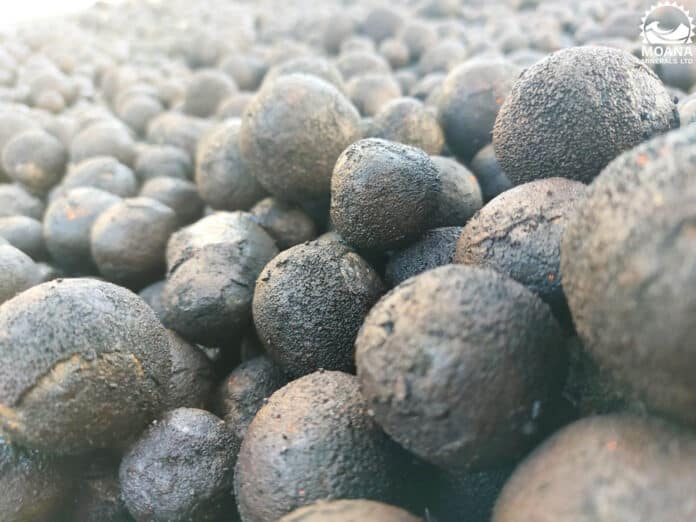
Companies are mere years away from extracting and shipping the first mineral-rich nodules back to the U.S., according to a top official tasked with implementing President Donald Trump’s push to unleash deep-sea mining in international waters.
Erik Noble, NOAA’s principal deputy assistant secretary for oceans and atmosphere, said Tuesday that he’s working to swiftly implement Trump’s executive order to fast-track exploration and production permits in waters beyond U.S. jurisdiction. Noble was notably dubbed the White House’s “eyes and ears” at NOAA during Trump’s first stint in office.
“What an exciting time to know that within in the next few years, under this administration, there will be companies pulling deep-sea nodules out of the ocean and bringing them to the U.S.,” Noble said at the American Council for Capital Formation’s offshore critical minerals forum in Washington.
Noble and a slew of other top federal regulators from across the federal government appeared at the summit hosted by ACCF, a business advocacy group now led by George David Banks, who served as a senior White House adviser on energy and climate during the first Trump administration.
Federal agencies in recent weeks have been moving quickly to implement a series of executive orders that Trump has inked to jump-start deep-sea mining and critical mineral production and processing.
One such order prompted NOAA last week to finalize a framework for companies like Vancouver-based The Metals Company, or TMC, to more quickly apply for permits to explore and extract minerals in areas beyond U.S. jurisdiction. NOAA has not yet issued a commercial permit.
But while proponents and Republicans have called for faster approvals to compete with China, environmental groups and Democrats have argued that the Trump administration is going “rogue” to support an industry that’s hampered by bankruptcies while trampling the International Seabed Authority’s work to create global safety rules under the Law of the Sea Convention, or LOSC.
“The Trump administration is supporting a new and highly destructive deep-sea mining industry in our ocean, despite immense environmental risks and broad international opposition,” Rebecca Loomis, a staff attorney for the Natural Resources Defense Council, wrote in a blog post Monday.
Megan Carr, the associate director of strategic resources at the Bureau of Ocean Energy Management, or BOEM, said a host of agencies along with the National Security Council and National Energy Dominance Council have crafted a plan to streamline permitting of offshore mining, which the White House is still reviewing.
BOEM, Carr also announced, is now mulling a potential mineral lease sale on the outer continental shelf off the coast of Alaska. It would be the first minerals lease sale off the state’s coast. BOEM is already considering leases in areas off the Atlantic, Pacific, Arctic and the Gulf coasts.
“This is a long time coming,” said Carr. “We’re in a place that we can take that knowledge and take that information and drive things forward and get it out into the public space so that it can garner the interest from all of you to hopefully … move forward with President Trump’s No. 1 priority, which is to advance industry toward development of these minerals.”
‘Government out of the way’
The Trump administration, said Noble, is “getting government out of the way” so the deep-sea mining industry can advance and mature after decades of stagnation and stressed that agencies like his can be “flexible” and have an open-door policy for industry.
“In 46 years, we only had four applications and four exploration licenses issues, two that lasted,” he said. “This last year alone, we have over 10 applications in our door. … I hope that continues and with our final rule … that more apply.”
Some of the companies that sponsored the business group’s conference or appeared at the event include TMC; Adepth Minerals, a Norwegian deep-sea mining company; Odyssey Marine Exploration, which is applying for a lease to mine off the shores of Virginia; and American Metals.
Carr echoed Noble’s comments and said that within the next few years she expects the federal permitting process at BOEM to be clearer and “less burdensome.
“We always want you to come to us,” she said, adding that public-private partnerships are going to be critical.
The administration also wants to foster deep-sea mining abroad.
Noble said he’s also focused on implementing another of Trump’s directives that calls on his top officials to forge mineral deals with U.S.-aligned countries, possibly using price floors.
The order specifically empowers Trade Representative Jamieson Greer and Commerce Secretary Howard Lutnick to “enter into negotiations with trading partners.” The goal, the order states, is to ensure mineral imports don’t threaten national security, following a monthslong federal review.
Noble, noting that he works for Lutnick, said the secretary wants to create “amazing opportunities with key partners that want to do development of critical minerals and deep-sea mining, either in their [exclusive economic zones] or to help with technology to help others get at deep-sea mining.”
“Who those are, it’s up to [Lutnick] to decide those conversations, but as a result of that, that’s why we sped towards engagement with the Cook Islands this past summer,” said Noble. “They were trying to make their decisions about what they were going to do in their waters. … [NOAA] provides the science, we provide our vessels.”
NOAA in its “most visible engagement” sent an exploration vessel, the Nautilus, to the Cook Islands within the span of three weeks.